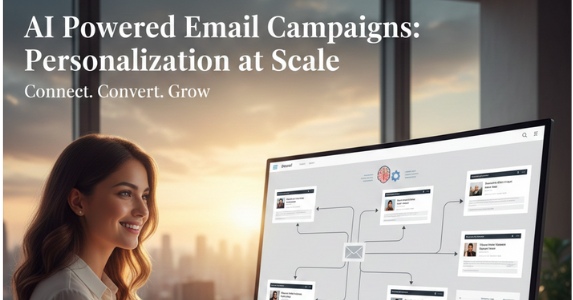
Email marketing remains one of the most effective digital marketing channels, offering a direct line of communication between businesses and their customers. However, the traditional approach to email campaigns, which relies on generic messages and broad targeting, is no longer sufficient in today’s highly competitive market. Consumers expect relevance, personalization, and timely content. This is where artificial intelligence transforms email marketing, enabling businesses to deliver personalized campaigns at scale.
AI powered email campaigns leverage machine learning algorithms, predictive analytics, and behavioral data to create customized experiences for each subscriber. By analyzing user behavior, preferences, and engagement history, AI can optimize email content, send times, frequency, and segmentation to improve performance and increase conversions.
Why Personalization Matters in Email Marketing
Personalization is no longer optional in email marketing. According to industry research, emails with personalized subject lines and content generate significantly higher open and click through rates than generic emails. Personalization creates a sense of relevance, increases customer engagement, and strengthens brand loyalty.
However, achieving personalization at scale is challenging with manual methods. Segmenting hundreds of thousands of subscribers and tailoring content for each group is time consuming and prone to error. AI solves this problem by automating the analysis, segmentation, and content personalization process, making it feasible to deliver individual experiences to large audiences.
How AI Enhances Email Campaigns
1. Advanced Audience Segmentation
AI can analyze subscriber data to identify patterns and create dynamic segments. These segments go beyond traditional demographics and include behavioral, transactional, and engagement metrics. For example, AI can segment subscribers based on purchase history, browsing behavior, email interactions, or predicted lifetime value. Dynamic segmentation allows marketers to target each group with highly relevant messages, improving engagement and conversion rates.
2. Predictive Analytics
Predictive analytics is a powerful feature of AI powered email campaigns. By analyzing past subscriber behavior, AI can forecast which content, offers, or products are most likely to resonate with each recipient. This predictive capability enables marketers to deliver emails that anticipate customer needs and preferences, increasing the likelihood of interaction and purchase.
3. Personalized Content Recommendations
AI can personalize email content for each subscriber, including product recommendations, offers, articles, or promotions. By analyzing previous interactions and preferences, AI can suggest the most relevant content for each user. This ensures that every email feels tailored to the recipient, creating a more engaging and valuable experience.
4. Optimal Send Time and Frequency
AI algorithms can determine the best time and frequency to send emails for each subscriber. By analyzing engagement patterns, AI identifies when users are most likely to open and interact with emails. This level of optimization reduces the risk of email fatigue, improves open rates, and maximizes the impact of each campaign.
5. A/B Testing and Continuous Optimization
AI simplifies A/B testing by automatically testing multiple email variations and identifying the most effective versions. It can evaluate subject lines, visuals, content, and call to action placement. With continuous optimization, AI ensures that campaigns improve over time based on real user behavior.
Benefits of AI Powered Email Campaigns
- Higher Engagement: Personalized emails generate higher open rates, click through rates, and interaction.
- Increased Conversions: AI predicts and delivers content that aligns with customer needs, driving more sales.
- Efficiency and Scalability: Automation reduces manual effort, allowing marketers to manage large subscriber lists without sacrificing personalization.
- Better Customer Insights: AI collects and analyzes data to provide actionable insights on customer behavior and preferences.
- Improved ROI: Targeted campaigns reduce wasted efforts, ensuring marketing budgets are spent on the most receptive audiences.
Examples of AI in Email Marketing
- E Commerce: AI recommends products in emails based on browsing history, abandoned carts, and purchase behavior.
- Content Marketing: AI suggests articles, guides, or resources tailored to each subscriber’s interests.
- Lead Nurturing: AI predicts which leads are ready to convert and sends targeted emails to encourage action.
- Re-Engagement Campaigns: AI identifies inactive subscribers and sends personalized incentives to re-engage them.
Best Practices for Implementing AI in Email Campaigns
- Collect High Quality Data: Accurate personalization depends on comprehensive and clean subscriber data.
- Start Small: Test AI capabilities on one campaign or segment before scaling to your entire list.
- Monitor Results: Continuously track key metrics such as open rates, click through rates, and conversions to optimize AI models.
- Balance Automation with Human Creativity: Use AI to deliver data driven personalization while maintaining creative messaging that aligns with your brand voice.
- Ensure Privacy Compliance: Follow regulations such as GDPR and CAN SPAM to protect subscriber data and maintain trust.
Future of AI in Email Marketing
AI will continue to evolve, making email campaigns even more intelligent and effective. Future developments may include real time content generation, hyper personalized product recommendations, and predictive engagement scoring. As AI becomes more sophisticated, marketers will be able to deliver fully customized email experiences that anticipate customer needs and drive sustained growth.
Conclusion
AI powered email campaigns represent a significant evolution in digital marketing. By leveraging machine learning, predictive analytics, and dynamic segmentation, businesses can deliver personalized email content at scale. This approach improves engagement, boosts conversions, and provides actionable insights into customer behavior.
Personalization at scale is no longer a distant goal but a practical reality with AI. Marketers who adopt AI in their email campaigns can build stronger relationships with their audience, optimize their marketing efforts, and achieve measurable results that drive long term business growth.