
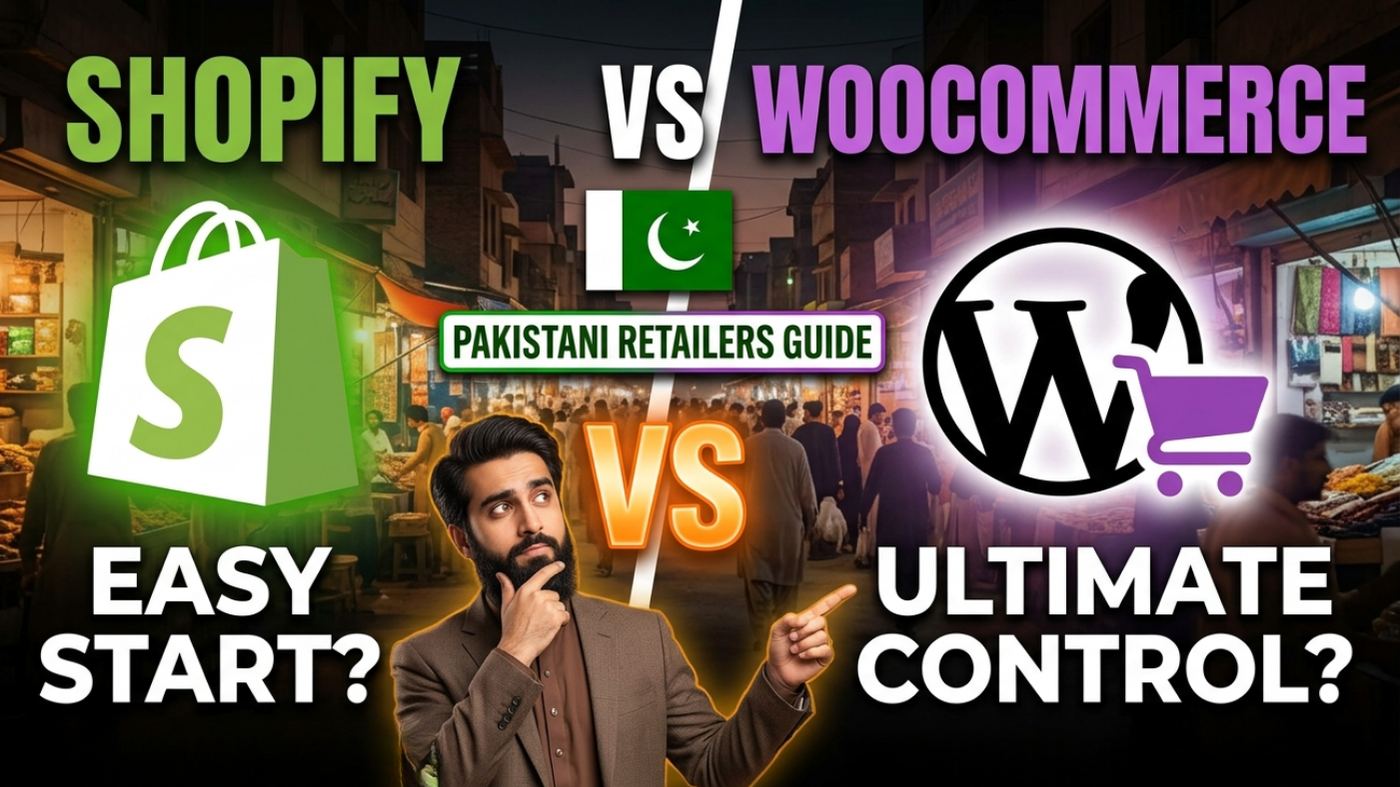
The e-commerce landscape in Pakistan is experiencing an unprecedented boom. From fashion hubs in Faisalabad’s D-Ground to manufacturing giants across Karachi and Lahore, retail brands are racing to establish their digital storefronts. However, the very first technical decision you face can make or break your online business: Should you build your store on Shopify or opt for a custom WooCommerce setup?
This single choice dictates your operational costs, your team’s daily workflow, your ability to handle flash sales, and how smoothly you can process Cash on Delivery (COD) and local digital payments.
In this guide, we will dissect the realities of running both platforms specifically within the Pakistani ecosystem. No generic advice—just raw data, localized operational challenges, and clear frameworks to help you choose the right engine for your digital growth.
- 1. The Quick Verdict: Core Differences at a Glance
- 2. Financial Architecture: Real Costs in Pakistan (USD vs. PKR)
- 3. Local Integrations: Payment Gateways and Courier APIs
- 4. Scalability & Performance: Handling Flash Sales
- 5. Ease of Use vs. Total Control: The Maintenance Dilemma
- 6. SEO & Visibility: Driving Organic Traffic
- 7. Final Comparison Matrix: Shopify vs. WooCommerce
- Conclusion: Engineering Your E-Commerce Destiny
1. The Quick Verdict: Core Differences at a Glance
Before diving into lines of code and transactional fees, it helps to understand the foundational philosophy behind each platform.
- Shopify is a closed-ecosystem, Software-as-a-Service (SaaS) platform. You pay a monthly subscription fee, and Shopify handles your hosting, security, and core infrastructure. It is built for speed, reliability, and ease of use.
- WooCommerce is an open-source, customizable plugin built on top of WordPress. You own everything outright—the files, the hosting, and the database. It offers absolute design and functional freedom but requires active management, security protocols, and engineering oversight.
For many scaling brands, partnering with an experienced digital marketing agency helps bridge the gap on either platform, ensuring that the backend infrastructure aligns perfectly with performance-driven ad campaigns.
2. Financial Architecture: Real Costs in Pakistan (USD vs. PKR)
For a Pakistani retailer, cost calculations are not straightforward. Because Shopify bills exclusively in US Dollars (USD), local businesses are highly vulnerable to currency fluctuations, state bank regulations on international SaaS payments, and withholding taxes on foreign digital services.
The True Cost of Shopify
While Shopify’s entry-level plans seem affordable, the ecosystem relies heavily on paid applications to unlock advanced features.
- Monthly Subscription: Paid in USD, meaning your monthly ledger changes based on the rupee’s valuation.
- Transaction Fees: If you use third-party payment providers (which is mandatory in Pakistan as Shopify Payments is unavailable natively), Shopify charges an additional 0.5% to 2% transaction fee on every order.
- App Subscriptions: Want a custom product bundler, an advanced loyalty program, or a specialized COD verification app? Those are billed monthly in USD, quickly ballooning your overhead.
The True Cost of WooCommerce
WooCommerce itself is completely free, but running a high-traffic, professional enterprise store incurs specific development costs.
- Premium Cloud Hosting: To match Shopify’s speed, you cannot use cheap, shared hosting. You need robust cloud hosting (such as DigitalOcean, AWS, or Vultr), which is scalable and stable.
- One-Time Development Asset: Instead of recurring monthly app fees, WooCommerce relies heavily on one-time purchase plugins or custom development features engineered by professional teams.
[Shopify Financials]     --> Recurring Monthly USD Fees + Per-Transaction Penalties
[WooCommerce Financials] --> Upfront PKR/USD Infrastructure Investment + Zero Transaction Penalties
Featured Snippet Optimization Rule: If you want predictable, fixed operational costs where your margins do not shrink when the USD climbs, a custom WooCommerce setup is financially superior for high-volume Pakistani retailers.
3. Local Integrations: Payment Gateways and Courier APIs
A brilliant user experience means nothing if your customer cannot complete their checkout smoothly, or if your fulfillment team has to manually copy-paste hundreds of addresses into courier portals every morning.
Payment Gateways (Alfa, JazzCash, EasyPaisa, brent)
In Pakistan, credit card penetration is growing, but alternative digital wallets dominate mobile transactions.
- Shopify Integration: Shopify supports international gateways like Payoneer and local integrations like brent, Alfalah Alfa, and CyberSource. However, configuring custom, multi-step checkout pages to show specific bank discounts can be restrictive due to Shopify’s locked checkout liquid files (unless you are on the enterprise-tier Shopify Plus).
- WooCommerce Integration: Because WooCommerce is completely open, you can integrate any local API seamlessly. Whether you want to build a custom payment flow for JazzCash, EasyPaisa, or direct bank transfers with automated receipt uploads, the programmatic freedom is infinite.
Cash on Delivery (COD) and Courier Automation
COD still accounts for roughly 80% to 90% of e-commerce transactions across Pakistan. Managing it efficiently is critical to reducing your Return to Origin (RTO) rates.
| Integration Requirement | Shopify Experience | WooCommerce Experience |
| Courier API Auto-Fulfillment (TCS, Leopards, Trax, BlueEx) | Relies on specific apps available in the Shopify app store. Can sometimes break if the courier updates their endpoint without updating the app. | Directly integrable via custom webhooks. Consistently stable and can be modified instantly by your development team. |
| OTP Order Verification (Reducing fake orders via SMS codes) | Requires premium third-party apps with recurring costs. Checkout customization constraints apply. | Easily built using affordable local SMS gateways. Zero ongoing software penalties beyond raw SMS credits. |
| City-Based Shipping Rates (e.g., lower rates within Faisalabad vs. outstation) | Requires advanced shipping setup plans or custom applications. | Out-of-the-box functionality. Infinite zoning parameters can be built natively. |
4. Scalability & Performance: Handling Flash Sales
Every major retailer in Pakistan looks forward to Blessed Friday, Ramadan shopping sprees, and seasonal lawn launches. During these windows, traffic spikes can jump from a few hundred active users to tens of thousands of concurrent shoppers within minutes.
Shopify: The Bulletproof Cloud
This is where Shopify shines exceptionally bright. Because it runs on a global, world-class cloud infrastructure, it can handle massive traffic surges without breaking a sweat. Your site will not crash during a midnight flash sale, and you do not need a system administrator sitting on standby to spin up extra servers.
WooCommerce: The High-Performance Engine
WooCommerce can scale just as effectively as Shopify, but it requires architecture design. If you attempt to run a major lawn brand launch on standard hosting, your server will bottleneck, resulting in a database connection error during checkout.
To achieve enterprise-grade scale on WooCommerce, you must implement:
- An optimized Object Cache (like Redis or Memcached).
- An enterprise-level Content Delivery Network (CDN) like Cloudflare Enterprise.
- A specialized website development agency to optimize database queries and prevent inventory race conditions.
5. Ease of Use vs. Total Control: The Maintenance Dilemma
Who is going to manage the day-to-day operations of your online store? Your answer here heavily influences which platform you should select.
The Shopify Philosophy: “Don’t Touch the Code”
Shopify is designed so that non-technical managers, inventory specialists, and founders can run the store with ease. The dashboard is intuitive, product uploading is seamless, and you never have to worry about core software updates breaking your layout. You compromise on customization, but you gain peace of mind.
The WooCommerce Philosophy: “Absolute Sovereignty”
With WooCommerce, you own your data entirely. No corporate entity can change their terms of service tomorrow and ban your store, nor can they increase transaction taxes arbitrarily. However, with great power comes great responsibility. You must actively manage:
- WordPress core and plugin updates.
- Daily automated backups.
- Security patches to prevent malware injections.
If you have a dedicated tech partner or work closely with specialists in branding and technical management, the maintenance overhead of WooCommerce becomes a non-issue, allowing you to reap the rewards of absolute platform ownership.
6. SEO & Visibility: Driving Organic Traffic
Paid Meta ads are excellent for instant revenue, but organic traffic from Google provides long-term, zero-cost sustainability.
- Shopify SEO: Shopify has a clean, rigid SEO framework out of the box. It automatically generates sitemaps and enforces canonical tags. However, its URL structure is locked. Your product pages will always contain
/products/and blog posts will contain/blogs/news/. This lack of URL flexibility can mildly restrict advanced semantic SEO grouping. - WooCommerce SEO: WooCommerce is widely regarded as an elite platform for search engine optimization. Utilizing advanced suites like RankMath or Yoast, you have surgical control over your robots.txt, schema markup strings, custom permalink URLs, and breadcrumb structures. For brands aiming to dominate highly competitive long-tail search terms in Pakistan, WooCommerce offers a distinct technical edge.
7. Final Comparison Matrix: Shopify vs. WooCommerce
| Evaluation Factor | Shopify Storefront | Custom WooCommerce |
| Hosting & Security | Included natively in the plan | Must be acquired and configured independently |
| Transactional Fees | 0.5% – 2% penalty for local gateways | 0% platform transaction fees |
| Custom Real Estate | Restricted by theme engines and Liquid files | 100% customizable across any visual layout |
| Pakistani Currency Stability | Vulnerable to USD valuation shifts | Fixed infrastructure maintenance metrics |
| Ideal Brand Profiles | Rapid market entry, minimal technical staff | Scaled retailers, custom business logic requirements |
Frequently Asked Questions (FAQ)
Q: Can I migrate my store from Shopify to WooCommerce (or vice versa) later?
A: Yes. Your product catalogs, customer databases, and order histories can be migrated between platforms using automated data maps. However, your visual design and custom app integrations will need to be rebuilt from scratch on the new platform.
Q: Which platform is safer from cyber attacks and data breaches in Pakistan?
A: Shopify is inherently secure because it is a closed system managed directly by global engineers. WooCommerce is incredibly secure only if it is hosted correctly, kept updated, and hardened with enterprise firewalls like Cloudflare.
Q: Do I need a credit card to run a Shopify store in Pakistan?
A: Yes, you generally need an international transactional credit/debit card or a virtual card with active e-commerce sessions enabled to pay for Shopify subscription bills and application fees in USD.
Conclusion: Engineering Your E-Commerce Destiny
There is no singular “correct” platform; there is only the platform that aligns with your operational realities, technical capabilities, and financial parameters.
- Choose Shopify if your primary goal is speed to market, you want a zero-maintenance infrastructure, and you are comfortable paying ongoing monthly fees in USD to ensure absolute platform stability.
- Choose WooCommerce if you want absolute sovereignty over your digital asset, require advanced custom functional workflows (like deep courier automation or unique local payment funnels), want to maximize your organic search margins, and prefer investing upfront in asset ownership rather than paying permanent rent to a third-party software provider.
Building a high-converting digital footprint requires tactical alignment across design, code, and consumer behavior analysis. Whether you choose to launch an agile SaaS storefront or design a scalable open-source portal, ensuring your backend is optimized for conversion is the ultimate key to market domination.
Ready to launch or optimize your e-commerce engine?
Discover how our tailored e-commerce web development and optimization services can elevate your brand, streamline your logistics, and turn digital traffic into sustainable revenue.